
A free 4-minute check for dog behaviour professionals
Where is your noise case stuck?
Take the quiz and discover which of four steps is most likely holding this case back + your first step towards resolving it
Free · about 4 minutes · for trainers, behaviourists and vets
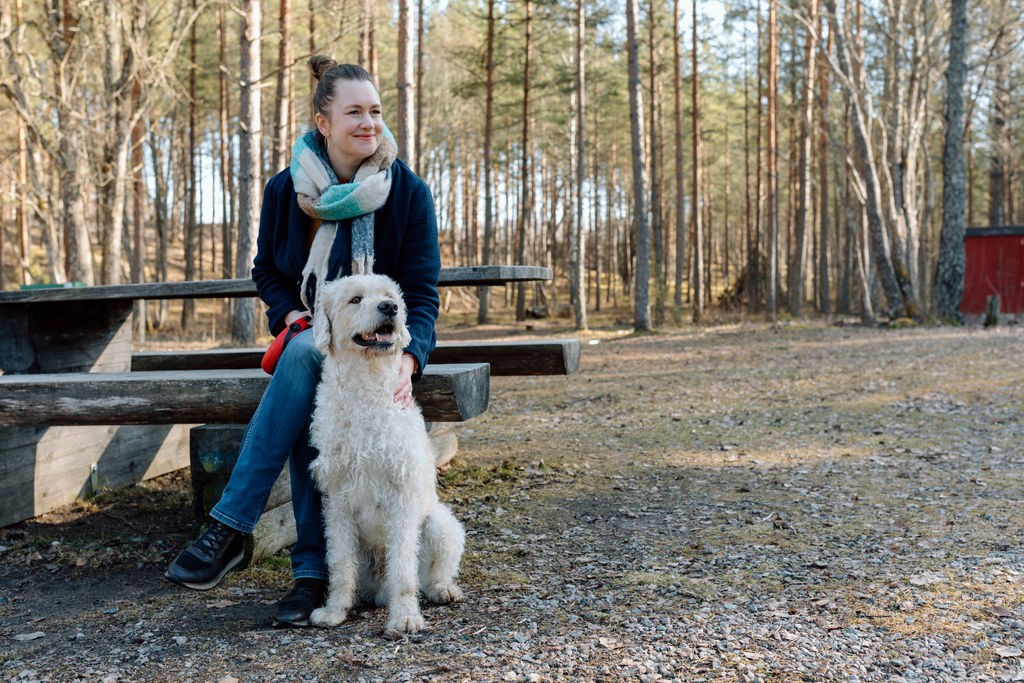
- Associate Professor of Animal Welfare
- More than 19 years of research on fear and stress in dogs
- Evidence-based solutions for fear and anxiety in dogs
You've taken the courses and developed a protocol by the book, and still the dog isn't progressing
Maybe it's the dog who copes quite well with the recordings during training, and then panics when the real fireworks start.
Or the dog who made good progress for a few weeks, until one bad evening took you back to where you started.
Or the case where you've tried the sound app, counter-conditioning, a calming wrap and a safe space, but nothing has worked so far. The owner is asking what to do next, and if you're honest, you're not completely sure either.
If one of these sounds familiar, you're in good company. In a Dutch study of more than 3,000 dogs, fewer than 30% of the most commonly used interventions had a lasting effect on noise fear (van Herwijnen et al., 2024).
So stuck noise cases are common. And in my experience, they're rarely about how hard you or the owner have worked.
A stuck case is usually stuck on one of four steps
When a noise case gets stuck, the natural next step is to look at the sound again: a lower volume, a different recording, a few more sessions. Sometimes that's exactly right.
But in most of the stuck cases I see, the sessions with the sound aren't the main problem. The case is stuck on one of these four steps:
Lowering the load
How much other daily stress the dog experiences. When that load is high, the threshold is already low before you have even started the training.
Building resilience
How quickly the dog recovers after a bang. A dog that needs hours to recover has little room left to learn.
Finding the starting point
Where the exposure begins, and whether you can see the threshold before the dog shows you the fear.
Exposure as learning
Whether the dog actually notices the sound during the sessions and learns that nothing bad follows. Or whether there is too little learning taking place.
Each of these needs something different. Until you know which one is holding this dog back, it's quite hard to know what to change. That's what the check helps you find.
What you'll see at the end of the check
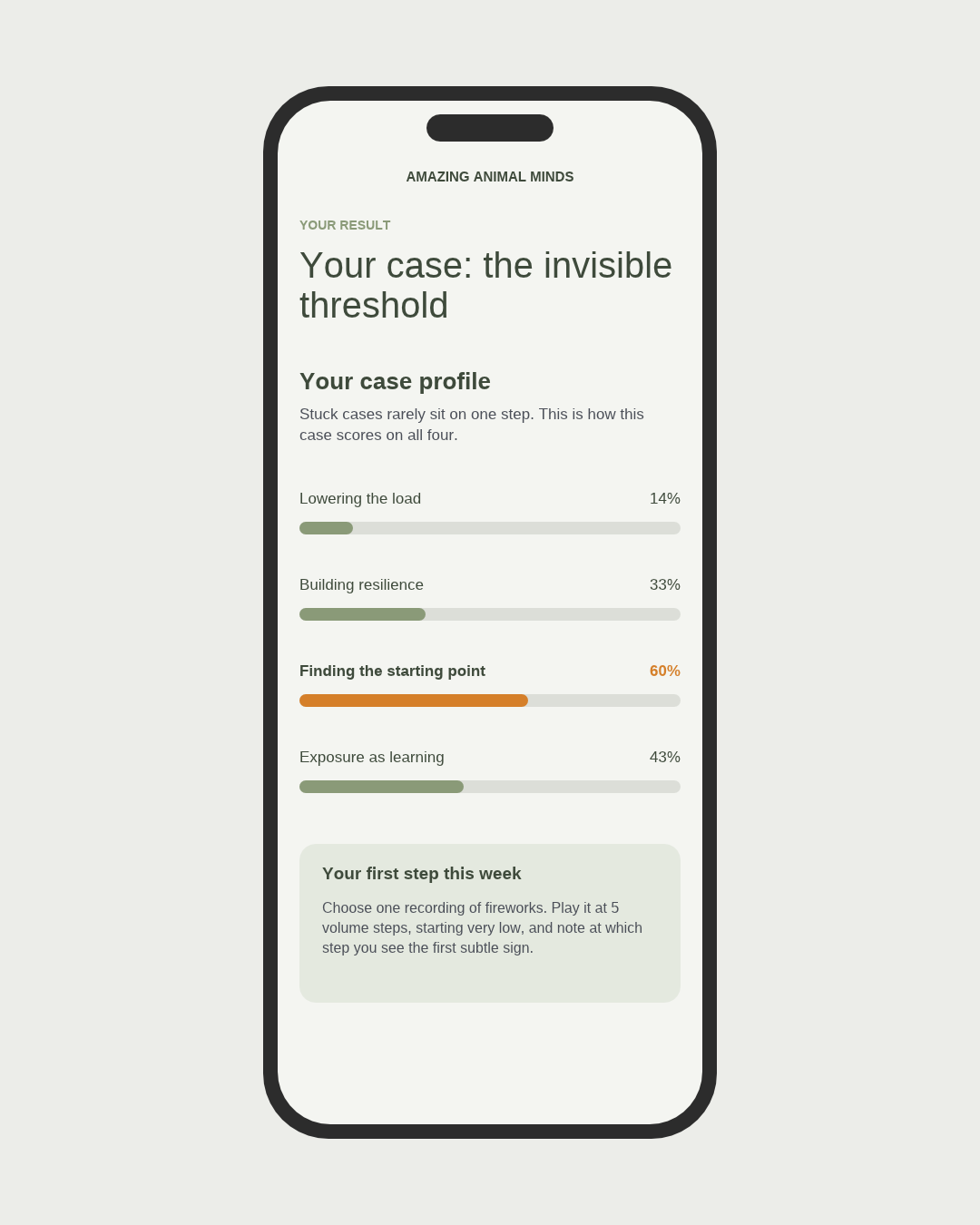
- Where this case is most likely stuck. Your case profile scores all four steps, so you can see which one stands out and where to look first.
- Why that step matters for the exposure work. Explained in plain language, so you can also explain the change of plan to the owner.
- What's already going well. Because a stuck case usually still has a few things that are working, and it helps to know which ones to keep.
- A first step you can take this week. Something concrete to try before the next session, and start working towards lowering the fear.
- Notes on what to rule out. When your answers point to pain, digestion or strong, spreading fear, the result tells you what's worth checking with a vet.
I'll also send the result to your inbox, so you can keep it as a reference.
"Most professionals know you should work below threshold. And yet this is where many noise cases get stuck, because the threshold is harder to find than it looks."
How it works
1
Think of one noise case that's stuck.
The dog where you thought you did everything by the book, and yet the dog wasn't progressing or had a relapse.
2
Answer 15 short questions about that dog.
About the trigger, the reactions, recovery, rest and sleep, pain and digestion, what's been tried so far and how the sessions are set up.
3
See your result straight away.
Your case profile across the four steps, what's most likely missing, and a first step for this week.
Free · about 4 minutes
The check is for you if
- You're a dog trainer, behaviourist, vet or vet nurse, or a student in a behaviour or training programme.
- You have a noise case that isn't progressing, or that improved and then relapsed.
- You want to understand what's driving the fear before you change your plan.
- You work force-free, and you want your approach to be evidence-based.
A note for dog owners: This check is written for professionals. If you're a dog owner, please look for a qualified, force-free behaviourist to coach you. Noise phobias are tricky, and they rarely resolve on their own.

The author
Who made this check
I'm Dr. Else Verbeek, Associate Professor in Animal Welfare at the Swedish University of Agricultural Sciences in Uppsala. I specialise in dog behaviour, stress, fear and the neurobiology behind them, and I've been researching this for more than 19 years.
With Amazing Animal Minds I teach dog professionals the science behind fear and stress, so they can understand what's driving a case before they choose a protocol. I built the Stuck Case Check so you can look at a stuck case the way I would. It asks the questions I ask at the start of every noise case, and it points you to where I would look first.
What professionals say about my noise phobia teaching
"The explanations of why dogs react this way was really enlightening. I also liked the myth busting part of the masterclass. I have certainly tried 'the wrong approach', but now I understand why it didn't work."
Jill
Dog trainer (masterclass)
"Understanding the complexity of noise phobias was a real eye-opener. I always found it a puzzle how to deal with unpredictable noises, but now, with what I learned in this course, I can offer my services with confidence."
Daniëlla
Dog trainer (course)
"For professionals committed to dog welfare, understanding and addressing noise fear is essential. The course offers a thorough, evidence-based, practical and empathetic approach. Each module gives usable strategies that can be adapted to the individual dog."
Hannah Ruess
Dog behaviour specialist (course)
Questions you might have
Start with the case that's on your mind
You probably already know which dog you'll think of. Answer 15 questions about that one dog, and you'll know where to look first, before the next session and well before New Year's Eve.
Free · about 4 minutes · for trainers, behaviourists and vets